Апартаменты
в Киеве
НАШ ТЕЛЕФОН
+38068-1980116
+38 044 222-58-42
+38068-1980116
SEARCH
Kiev-Pechersk Lavra
| | | Kiev-Pechersk Lavra |
|
The Kiev-Pechersk State Historico-Cultural Monument is located in one of the picturesque spots of Pechersk District of Kiev on two large hills. Crowned with shining gold domes the ancient stone structures loom above the Dnieper. The numerous buildings of the monument form an ensemble of outstanding models of the architecture of the XI – XVIII centuries. This ensemble began to be formed in 1051 at the time of the foundation of the Kiev-Pechersk Monastery, later called the Lavra. (Lavra is a Greek word meaning, literally, a built-up street, a city district). The name “Pechersk” was given to the monastery from the catacombs (pechery) in which it was founded. During the course of centuries the Kiev-Pechersk Lavra was a centre of religious propaganda, acting with the extensive support of the ruling classes and the most important shrine of religious pilgrimage in the Russian Empire. From the XI century on, the Kiev-Pechersk Lavra was a big feudal landlord, cruelly exploiting serf peasants and small artisans. In the XVIII century the Lavra possessed hundreds of thousands of acres of land, owned about eighty thousand serfs and several hundred enterprises and commercial establishments. The serfs, unable to tolerate the cruel exploitation, frequently rebelled or ran away. The protests of the peasants were ruthlessly suppressed. The exploitation of the religious feelings of the believers was the chief sourse of the monastery`s income. For this purpose an intricate system was set up for attracting and beguiling the pilgrims. Besides the gloomy catacombs with “saintly relics” and “miracleperfoming” icons, the Lavra clergy strengthened religion with the aid of art – painting, architecture, the goldmith`s art, etc. By these means strong religious emotions were aroused in the believers, thus inducing them to give up their hard-earned coppers to the monastery. The spplendour of the churches, their rich decorations, produced a great impression on the broad mases of the population, furthered the propagation and consolidation of religious faith in working people, inculcated the ideas of submissiveness to temporal and ecclesiastical rule. By the end of the XVIII century an ensemble of original architectural monuments had grown up on the grounds of the Kiev-Pechersk Lavra which eternally preserves the labour of many generations of our people, embodied in remarkable artistic models of the talent, skill, ideas and emotions of many gifted builders, artists, wood-carvers, stone masons, moulders, jewellers and other craftsmen. Many of them were of the people, serfs of the monastery. They contributed folk motifs in their art, and this was reflected in the architecture of the Lavra edifices. 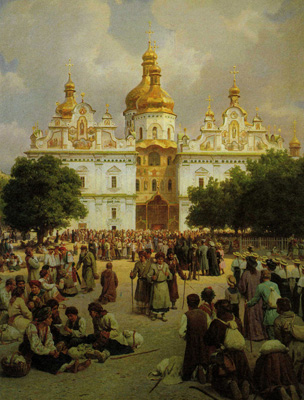 The oldest architectural models of the monument are the Uspensky (Assumption) Cathedral (1073 – 1078), the Troitskaya (Trinity) Church surmounting the gate (1106 – 1108), the Church of Spas na Berestove (Our Saviour of Berestovo) (end of the XI, beginning of the XII century). The oldest architectural models of the monument are the Uspensky (Assumption) Cathedral (1073 – 1078), the Troitskaya (Trinity) Church surmounting the gate (1106 – 1108), the Church of Spas na Berestove (Our Saviour of Berestovo) (end of the XI, beginning of the XII century).The Uspensky Cathedral – the principal building of the Kiev-Pechersk Monastery – was a cross-domed church, typical of ancient Russian architecture. The interior walls were ornamented in 1082 – 1089 by frescos and mosaics. The cathedral had a great influence on the architecture of the period of feudal disjunction, became a model of ecclesiastical building in monasteries, princely estates and in the urban centres of the Old Rus state. The cathedral has not come down to us in its original form. In 1230 it was partially wrecked to a large extent by the Tartar-Mongol hordes and then by the Crimean Khans. In 1718 the building was devastated by a conflagration. The cathedral was rebuilt in 1722 – 1729 after designs by the architect Fyodor Vasilyev under the direction of the master builder I.I.Kalandin. The sumptuous moulding was executed by the folk craftsman Iosif Belinsky of Kanev; the painting by the Kiev masters A.Glinsky and Stefan Lubensky. Somewhat later the folk craftsman Stepan Kovnir, a serf of the Lavra, decorated the façade of the cathedral with fantastic pediments. In 1941 the cathedral was plundered and wrecked by the fascists. The Troitskaya Church surmounting the main gate is a small four-column single-domed structure. Of great artistic value are the mural paintings in the church, executed by Kiev artists (1734) and the carved gilded wooden iconostasis, done in the same year by Chernigov wood-carvers. Defensive walls, built in 1695 – 1698 , odjoin the Troitskaya Church on the south and north. The Spas na Berestove Church stands isolated to the north of the Economical Gates. In ancient times the village of Berestovo, where the prince`s court was located, was situated on this spot. Berestovo is often mentioned in the chronicles as a place where the princes Vladimir Svyatoslavovich, Yaroslav the Wise, his sons and grandsons sojourned. Mural painting of 1643 is preserved inside the church. In 1157 the founder of Moscow Prince Yuri Vladimirovich Dolgoruky was buried in this church. The most numerous group of buildings in the monastery is composed of monuments of Ukrainian architecture of the XVII – XVIII centuries, which flourished as a result of the rapprochement of Russian and Ukrainian architecture after the reunion of Russia and Ukraine. The plastic treatment of spaces, the light and shadow effects, the interweaving of baroque décor with Ukrainian folk ornamentation and decorative details of Russian architecture – such are the architectural features of the monastery buildings of that period. Even the Old Rus structures – the Uspensky Cathedral and the Troitskaya Church – subsequently acquired a typical baroque decorative ensemble. Among the outstanding architectural monuments of those times is the Vsekhsvyatskaya (All Saints) Church surmounting the Economical Gates (1696 – 1698). It repeats the type of Ukrainian wooden five-domed churches. Very interesting buildings are the Nicolskaya Church (end of XVII century), the Krestovozdvizhenskaya (Holy Cross) Church at the Near Catacombs (XVII c.). Of great interest are the residential and economical buildings of the times: the building of the printing shop with its original supporting arches, the Kovnir building with exquisite pediments along the southern façade, models of Ukrainian civil buildings – buildinga No.3 and No.4. Taking into consideration the importance of monuments of the past, the Soviet government of the Ukraine issued a special decree in 1926 declaring the grounds of the Kiev-Pechersk Lavra a state historico-cultural monument. At present museums and exhibitions have been opened on the grounds of the monument. By the materials of A.I.Popchenko and V.A.Shydenko |
|


